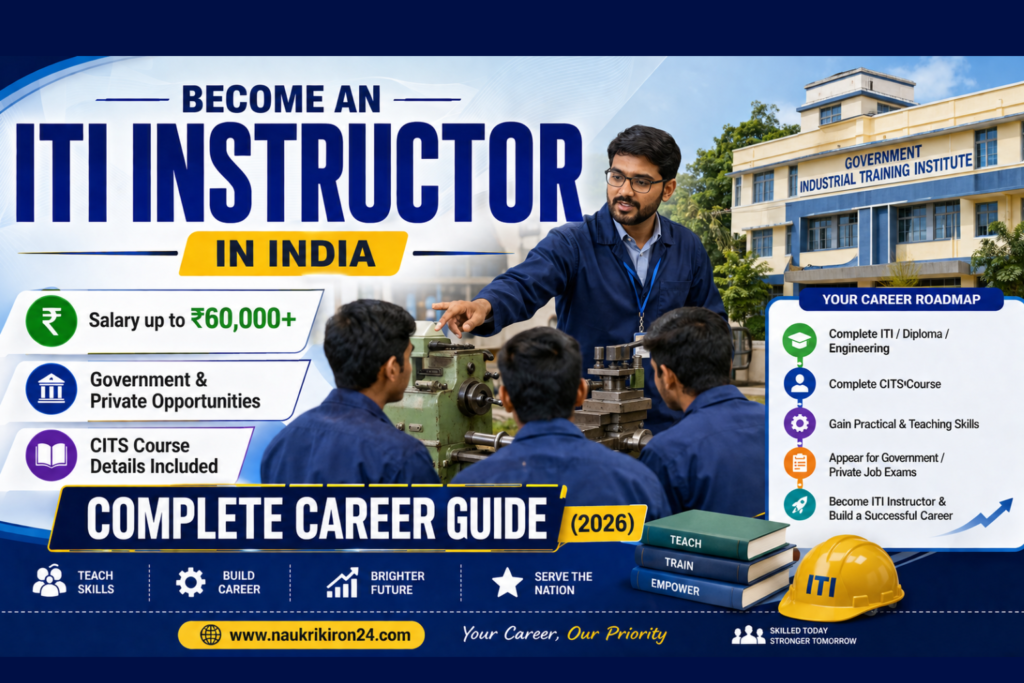
How to Become an ITI Instructor in India: If you have an ITI certificate, diploma or engineering qualification and are interested in technical education, becoming an ITI instructor can be a career option worth exploring.
An ITI Instructor combines technical knowledge, practical training and teaching skills to help students develop job-oriented skills. However, the qualification required to become an instructor is not identical for every trade or recruitment. Eligibility can depend on the trade, educational qualification, instructor-training requirements and the rules specified by the recruiting organisation.
One important pathway is the Craft Instructor Training Scheme (CITS) administered by the Directorate General of Training (DGT). DGT states that CITS provides training in both technical skills and training methodology and currently covers 55 trades.
This guide explains the career pathway, CITS, qualification requirements, skills, job opportunities, salary considerations and practical steps candidates can follow.
What Does an ITI Instructor Do?
An ITI instructor is responsible for helping trainees develop practical and theoretical knowledge in a particular vocational trade.
Depending on the institute and trade, responsibilities may include:
- Conducting practical training sessions
- Explaining technical concepts
- Demonstrating workshop procedures
- Guiding students during practical work
- Preparing training activities
- Maintaining workshop discipline and safety
- Assessing student performance
- Helping trainees understand industry practices
- Maintaining training-related records
The exact duties can differ between government ITIs, private ITIs and other vocational-training organisations.
ITI Instructor Career Overview
| Particular | Details |
| Career | ITI Instructor |
| Sector | Vocational & Technical Education |
| Qualification | ITI/Diploma/B.Tech + CITS |
| Salary | ₹35,000–₹1,00,000+ |
| Job Sector | Government & Private |
| Career Growth | Excellent |
| Experience Required | Depends upon recruitment rules |
| Main Training Pathway | CITS, where applicable |
| Common Entry Backgrounds | NTC/NAC, Diploma or Degree, depending on trade |
| CITS Duration | Generally 1 year |
| CITS Trades | 55 trades currently listed by DGT |
| Employment Sector | Government & Private |
| Experience | Depends on the recruitment rules |
| Salary | Depends on employer, trade, pay structure and experience |
DGT’s current CITS information confirms that candidates with NTC/NAC/Diploma/Degree qualifications can be eligible for CITS, but the exact entry qualification must be checked for the particular trade.
Who Can Become an ITI Instructor?
There is no single qualification that automatically makes every candidate eligible for every ITI Instructor vacancy.
Depending on the trade and recruitment rules, candidates may come from backgrounds such as:
- National Trade Certificate (NTC)
- National Apprenticeship Certificate (NAC)
- Diploma
- Engineering Degree
- Other trade-specific qualifications
- Relevant technical experience, where permitted
The important point is that eligibility is trade-specific.
For example, DGT’s CITS course information lists different combinations of degree, diploma and NTC/NAC qualifications for different trades. Therefore, candidates should never assume that an ITI certificate, diploma or B.Tech degree alone guarantees eligibility for an instructor position.
What Is CITS?
CITS stands for Craft Instructor Training Scheme.
It is the instructor-training programme administered by the Directorate General of Training (DGT). The programme provides training in both the technical area and the methodology required to transfer practical skills to trainees.
The purpose of CITS is different from an ordinary technical qualification. Instead of only developing trade skills, the programme also focuses on preparing candidates to teach and train other learners.
CITS training can include areas such as:
- Trade-specific technical knowledge
- Teaching methodology
- Practical demonstrations
- Workshop management
- Training techniques
- Assessment-related skills
- Safe working practices
DGT currently lists CITS courses across 55 trades, including engineering and non-engineering trades.
Official CITS Information
Candidates can check the latest course list and eligibility requirements on the official DGT CITS portal before applying.
Is CITS compulsory for an ITI instructor?
This is one of the most important points in this career guide.
Do not assume that CITS is compulsory for every instructor vacancy in every organisation.
The requirement depends on the recruitment rules and the particular post. DGT states that CITS is the instructor-training pathway within its training ecosystem, while individual recruitment notifications can specify their own eligibility requirements.
Therefore, before applying for an instructor vacancy, check:
- Required trade
- Educational qualification
- CITS/NCIC requirement
- Experience requirement
- Age limit
- Selection process
- Recognition requirements
This approach is safer than claiming that every ITI instructor must have exactly the same qualification.
CITS Eligibility
DGT’s current CITS information states that eligible candidates can include those holding NTC, NAC, Diploma or Degree qualifications. However, the exact qualification varies according to the selected CITS trade.
For example, DGT’s Information Technology CITS course lists specific combinations involving engineering/technology degrees, relevant diplomas and NTC/NAC qualifications.
Therefore:
Before choosing a CITS course, check the entry qualification for your specific trade on the official DGT CITS course list.
This is particularly important for candidates who are deciding between ITI, diploma and engineering-based pathways.
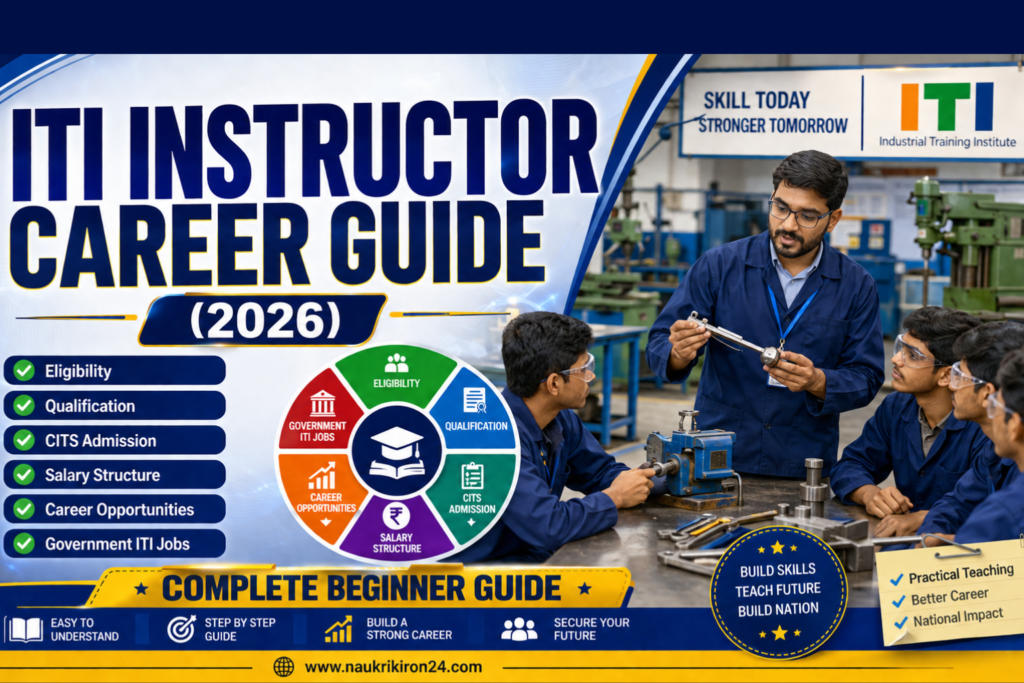
How to Become an ITI Instructor: Step-by-Step Roadmap
Step 1: Choose Your Technical Trade
First, decide which technical or vocational field you want to teach.
Examples include:
- Fitter
- Electrician
- Welder
- Computer-related trades
- Mechanical trades
- Automotive trades
- Electronics
- Other CITS-approved trades
Your previous qualification should be relevant to the trade you want to pursue.
Step 2: Complete the Required Technical Qualification
Depending on your chosen pathway, this may involve:
- ITI/NTC
- NAC
- Diploma
- Engineering Degree
The exact requirement depends on the trade and the recruitment or CITS admission rules.
Step 3: Consider CITS
If your career goal is technical instruction, CITS is an important qualification to investigate.
DGT describes CITS as the instructor-training programme designed to develop both trade skills and training methodology.
Step 4: Develop Teaching Skills
Technical knowledge alone does not automatically make someone an effective instructor.
Work on:
- Communication
- Demonstration skills
- Classroom management
- Workshop safety
- Problem-solving
- Presentation
- Student assessment
- Digital learning tools
Step 5: Monitor Recruitment Notifications
Once you have the required qualifications, monitor vacancies from:
- State government departments
- Government ITIs
- Central government organisations
- Private ITIs
- Skill-training organisations
- Industrial training centres
Always read the original recruitment notification before applying.
CITS Course Duration
The CITS programme is generally structured as a one-year course, although the exact structure and trade details should be checked against the current DGT information for the relevant course.
For example, DGT’s current course information lists several CITS programmes as one year/two semesters.
Candidates should therefore check the current course page rather than relying on an old admission article.
Skills Required to Become an ITI Instructor
A good instructor needs a combination of technical and teaching abilities.
Technical Skills
- Strong understanding of the trade
- Practical workshop knowledge
- Equipment handling
- Safety awareness
- Troubleshooting ability
Teaching Skills
- Clear communication
- Demonstration ability
- Patience
- Classroom management
- Student assessment
- Presentation skills
Professional Skills
- Time management
- Teamwork
- Problem-solving
- Record keeping
- Continuous learning
Government ITI Instructor Jobs
Government instructor vacancies can be advertised by different authorities, depending on the state, department and recruitment structure.
Candidates should therefore avoid assuming that there is one nationwide recruitment process.
Before applying, check:
- Recruiting authority
- Trade
- Qualification
- CITS requirement
- Age limit
- Experience
- Pay level
- Selection process
- Application deadline
The DGT also explains that ITIs are administered by State Governments or Union Territory administrations, while DGT is responsible for national-level policies, standards, instructor training and trade testing within its areas of responsibility.
Private ITI Instructor Opportunities
Private-sector opportunities may be available in:
- Private ITIs
- Vocational training centres
- Industrial training organisations
- Corporate skill-development centres
- Apprenticeship training programmes
- Technical training departments
Private employers can establish their own recruitment criteria, so candidates should carefully read each vacancy before applying.
ITI Instructor Salary
There is no single salary applicable to all ITI instructors.
Pay can vary according to:
- Government or private employment
- State
- Trade
- Pay level
- Qualification
- Experience
- Employer
- Recruitment rules
Therefore, I recommend removing the old fixed salary table, such as ₹35,000–₹100,000+, unless you have a specific recruitment notification supporting those figures.
For government posts, use the exact pay level or salary stated in the relevant notification.
For private positions, use the salary stated by the employer where available.
This makes the article more accurate and prevents readers from treating a general estimate as a guaranteed salary.
Career Growth for an ITI Instructor
Career progression depends on the employer and recruitment rules.
Possible long-term roles can include:
- Senior Instructor
- Training Officer
- Workshop-related supervisory positions
- Training Manager
- Technical Trainer
- Technical Consultant
However, these titles and promotion paths are not universal. Candidates should check the service rules of the organisation where they work.
Advantages of This Career
Becoming an ITI instructor can be suitable for people who enjoy both technical work and teaching.
Potential advantages include:
- Opportunity to use technical knowledge
- Interaction with trainees
- Practical teaching experience
- Opportunities in government and private training
- Scope for professional development
- Contribution to vocational education
However, candidates should also consider the responsibilities of teaching, workshop management and continuous skill development before choosing this career.
Challenges You Should Know About
This career also has practical challenges.
1. Trade-Specific Eligibility
Your qualification may be suitable for one trade but not another.
2. Competitive Recruitment
Government instructor vacancies can attract many applicants.
3. Continuous Learning
Technology and industrial practices change, so instructors need to keep their technical knowledge current.
4. Teaching Responsibility
An instructor is responsible not only for knowing the subject but also for explaining it effectively.
How to Prepare for an ITI Instructor Job
If you want to pursue this career, follow a structured approach:
- Identify your technical trade.
- Check the relevant CITS qualification.
- Complete the required qualification.
- Develop practical skills.
- Improve communication and teaching ability.
- Follow official recruitment websites.
- Read every recruitment notification carefully.
- Prepare documents in advance.
- Practice relevant examinations where applicable.
- Apply only when your qualifications match the official requirements.
Current CITS 2026–27 Information
For candidates planning to pursue instructor training in 2026, this section is particularly important.
DGT currently publishes information relating to CITS admissions for the 2026–27 session, including the admission schedule and advertisement.
Candidates should check the latest DGT information rather than relying on dates from older articles.
Outside Link:
Check Official DGT CITS Information
CITS Course List:
View CITS Courses and Trade-wise Eligibility
Related Career & Job Opportunities on NaukriKiron24
If you are interested in technical jobs, government recruitment and skill-based career opportunities, you can also explore:
- ITI Instructor Recruitment 2026 – Latest Instructor Job Opportunities
- Railway Government Jobs Without Experience 2026 – West Bengal
- AIIMS CRE 5 Recruitment 2026 – Check Eligibility & Application Details
- West Bengal Skipper Recruitment 2026 – Diploma & ITI Jobs
FAQs
Q1. Is CITS compulsory for every ITI Instructor job?
Not necessarily for every organisation and vacancy. Requirements depend on the trade and recruitment rules. Candidates should check the individual notification. DGT identifies CITS as its instructor-training programme and provides trade-specific eligibility information.
Q2. Can an ITI pass candidate pursue CITS?
Yes, an NTC/NAC qualification can be accepted for relevant CITS trades, but the exact trade-wise requirement must be checked before admission.
Q3. Can Diploma holders apply for CITS?
Yes. DGT’s current CITS information includes Diploma qualifications among the eligible backgrounds, subject to the requirements of the selected trade.
Q4. Can engineering graduates pursue CITS?
For several CITS trades, degree-level qualifications are accepted. However, the degree must match the specific entry requirements of the selected trade.
Q5. How long is CITS?
Many CITS programmes are structured as one year/two semesters. Check the individual DGT course page for the exact programme.
Q6. Where can I check official CITS information?
The best starting point is the official DGT CITS section and its trade-wise course information.
Conclusion
Becoming an ITI Instructor can be a suitable career path for candidates who enjoy technical education, practical training and working with learners. However, there is no single qualification or recruitment rule that applies to every instructor position.
The most important step is to identify your trade and then check the corresponding DGT/CITS eligibility requirements and recruitment notification. CITS is particularly important because it is designed specifically to develop instructor skills alongside technical knowledge.
Candidates should also avoid relying on fixed salary claims or blanket statements about eligibility. Instead, compare your qualification with the official requirements for each vacancy and keep your technical and teaching skills updated.
Official Links
| Official Resource | Link |
|---|---|
| DGT – Craft Instructor Training Scheme (CITS) | Visit Official DGT CITS Page |
| DGT – CITS Courses | View Trade-wise CITS Courses & Eligibility |
| DGT – CITS 2026–27 Information | Check CITS 2026–27 Updates |
| NSTI Kolkata – CITS Courses | View CITS Courses at NSTI Kolkata |

yes