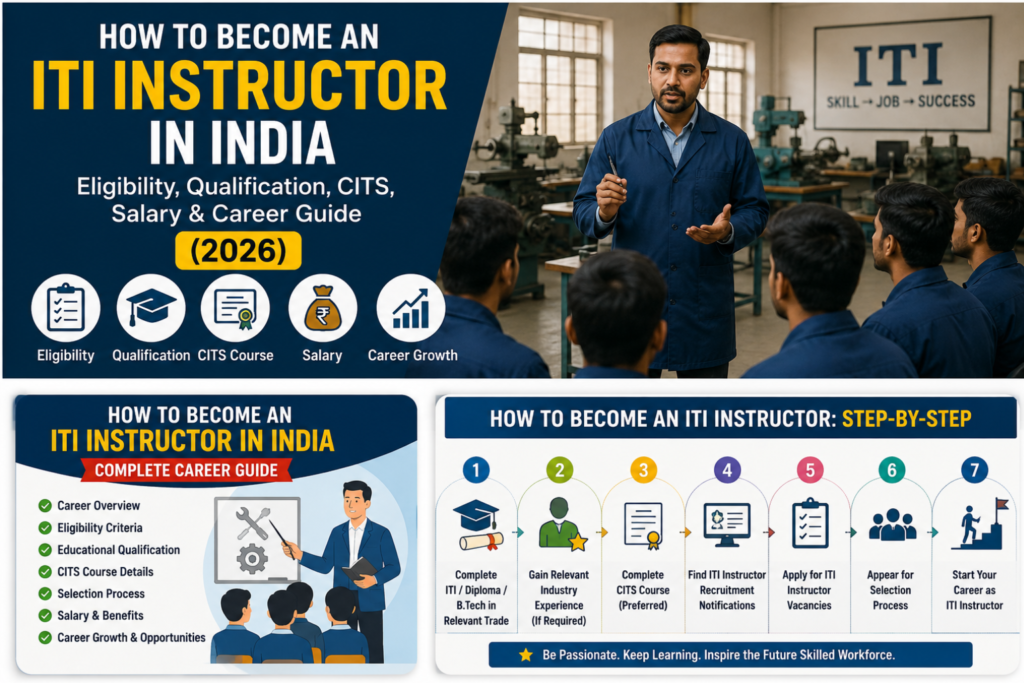
How to Become an ITI Instructor in India: Becoming an ITI Instructor can be a suitable career path for candidates who have a technical background and enjoy teaching practical skills. ITI Instructors play an important role in vocational education by helping students develop the technical knowledge and hands-on abilities required for employment.
Depending on the trade and recruitment authority, candidates with ITI, Diploma, or Engineering qualifications may find opportunities in instructor-related positions. However, eligibility is not identical for every post, so candidates should always verify the qualification, experience, age limit, and other requirements mentioned in the relevant recruitment notification.
This guide explains the ITI Instructor career path in simple terms, including eligibility, CITS, required skills, career opportunities, salary factors, and the steps candidates can follow to prepare for this profession.
What Does an ITI Instructor Do?
An ITI Instructor is responsible for helping trainees understand both the theoretical and practical aspects of a particular technical trade. The work is not limited to classroom teaching; instructors may also demonstrate tools, machines, equipment, and workplace procedures.
Typical responsibilities can include preparing lessons, conducting practical demonstrations, monitoring trainee performance, maintaining workshop discipline, following safety procedures, and helping students understand how their trade skills are applied in real working environments.
The exact duties depend on the trade, institute, and position. An instructor working in an Electrician trade, for example, may have different practical responsibilities from an instructor teaching Fitter, Welder, Mechanic, or Computer-related trades.
Who Can Become an ITI Instructor?
There is no single qualification that applies to every ITI Instructor position in India. Recruitment requirements can vary according to the trade, department, state, and level of the post.
Generally, candidates may come from one of the following technical backgrounds:
- ITI qualification in the relevant trade
- Diploma in a relevant engineering discipline
- B.E. or B.Tech. in the relevant field
- Relevant industrial or teaching experience, where required
- CITS qualification, where prescribed or preferred
Candidates should not assume that having an ITI, Diploma, or B.Tech qualification automatically makes them eligible for every instructor vacancy. The trade-specific recruitment notification should always be treated as the final eligibility reference.
What Is CITS and Why Is It Important?
The Craft Instructor Training Scheme (CITS) is an instructor-training programme designed to develop the teaching capabilities of candidates who want to work in vocational training.
Technical knowledge alone does not always make someone an effective instructor. An instructor must also know how to explain concepts, demonstrate practical procedures, manage training sessions, and assess learners.
CITS can help candidates develop areas such as:
- Instructional and teaching techniques
- Practical demonstration methods
- Workshop management
- Lesson planning
- Trainee assessment
- Safety awareness
- Trade-specific instructional skills
Whether CITS is compulsory depends on the specific recruitment rules. Therefore, candidates should check the official notification before deciding whether the qualification is mandatory for a particular vacancy.
Eligibility and Qualification Requirements
The eligibility criteria for ITI Instructor recruitment can differ considerably between organisations. Candidates should check the notification for the exact trade-specific qualification rather than relying only on general information available online.
Depending on the vacancy, the recruitment authority may specify requirements related to:
- Educational qualification
- Relevant trade or engineering discipline
- CITS certification
- Industrial experience
- Teaching experience
- Age limit
- Category-based relaxation
- Other technical or professional requirements
This is particularly important for government recruitment because even a small difference between the candidate’s qualification and the prescribed trade requirement can affect eligibility.
Skills Required to Become a Good ITI Instructor
A successful ITI Instructor needs more than a certificate or academic qualification. The ability to communicate technical concepts clearly is equally important.
Useful skills include:
- Strong technical knowledge
- Practical problem-solving ability
- Clear communication
- Workshop safety awareness
- Demonstration skills
- Classroom management
- Patience while training beginners
- Basic computer knowledge
- Time management
- Ability to assess trainee performance
Candidates can develop these skills through practical experience, instructor training, workshops, and regular practice.
ITI Instructor Salary in India
There is no single salary applicable to every ITI Instructor in India. Government and private institutions can follow different salary structures, while pay can also vary according to the post, state, experience, qualification, and organisation.
Government instructor positions may follow the applicable state or central pay structure. Private institutes may offer salaries based on experience, trade, location, and institutional requirements.
Therefore, instead of assuming a fixed salary, candidates should check the salary mentioned in the specific recruitment notification or employment advertisement.
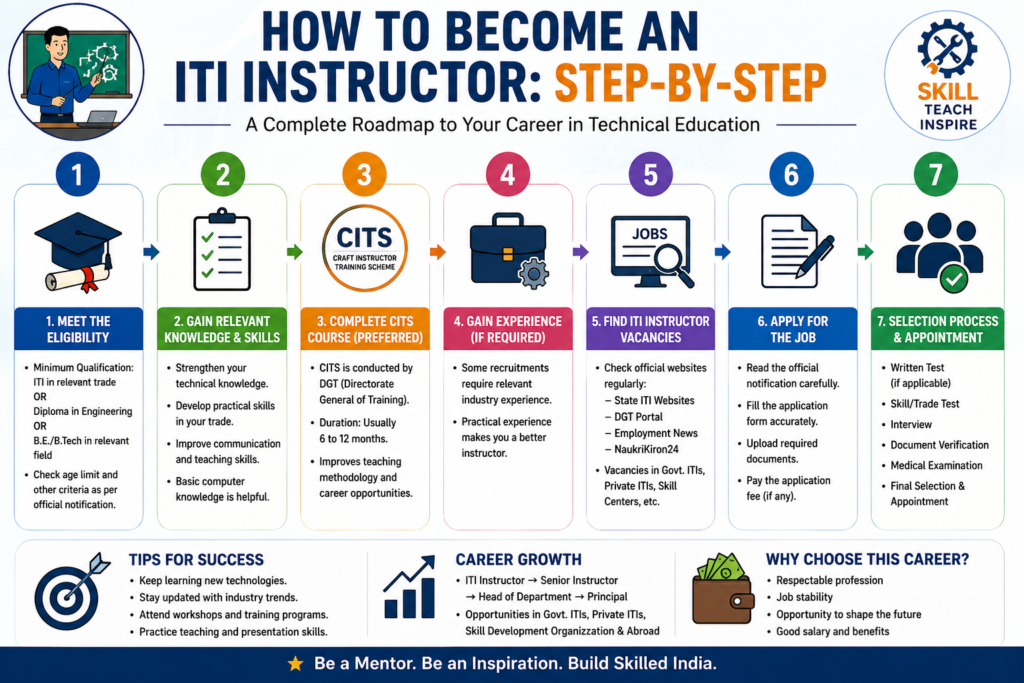
How to Become an ITI Instructor: Step-by-Step Roadmap
Candidates interested in this career can follow a practical roadmap:
Step 1: Choose a Relevant Technical Field
Complete an ITI course, Diploma, or Engineering qualification in a trade or discipline relevant to the instructor position you want to pursue.
Step 2: Build Practical Knowledge
Try to gain hands-on experience with tools, machines, equipment, software, or processes related to your trade. Practical knowledge can make technical teaching easier.
Step 3: Consider CITS
If CITS is relevant to your intended instructor career, explore the applicable course and admission requirements through the appropriate official authority.
Step 4: Develop Teaching Skills
Work on explaining technical concepts in simple language. Practice demonstrations, presentations, and step-by-step explanations.
Step 5: Monitor Recruitment Notifications
Check government recruitment portals, state technical education departments, and recognised training organisations for instructor vacancies.
Step 6: Check Eligibility Before Applying
Before submitting an application, compare your qualification, trade, experience, age, and other details with the official recruitment notification.
Step 7: Prepare for Selection
Depending on the recruitment authority, the selection process may involve a written examination, trade test, practical assessment, interview, or document verification.
Where Can ITI Instructors Work?
Qualified instructors may find opportunities across different types of training organisations.
Potential workplaces include:
- Government Industrial Training Institutes
- Private ITIs
- Vocational training centres
- Skill development institutions
- Apprenticeship training centres
- Industrial training organisations
- Corporate technical training departments
The availability of vacancies depends on recruitment requirements and the candidate’s trade or specialisation.
Government ITI Instructor Opportunities
Government instructor positions can be attractive because they may offer structured recruitment procedures, defined service conditions, and opportunities for professional development.
However, government vacancies are not available continuously for every trade. Candidates should therefore monitor official recruitment notices instead of relying on old vacancy information.
When a vacancy is announced, carefully check the official notification for the number of posts, trade-wise qualification, age limit, selection procedure, salary, application dates, and other conditions.
Related Career & Job Opportunities on NaukriKiron24
If you are exploring technical and private-sector career opportunities, you can also read:
- Syrma SGS Technology Recruitment 2026 – Manufacturing Jobs
- TAFE Tractors Manufacturing Jobs 2026 – Latest Opportunities
- ITI Instructor Recruitment 2026 – Latest Instructor Vacancies
How to Prepare for an ITI Instructor Recruitment
Preparation should begin before a recruitment notification is released. Candidates can start by strengthening their core trade knowledge and revising important technical concepts.
A practical preparation strategy includes:
- Revise your core ITI, Diploma, or Engineering subjects.
- Improve practical knowledge related to your trade.
- Study the syllabus mentioned in the official notification.
- Practise previous examination questions when available.
- Improve communication and teaching skills.
- Keep educational and experience documents organised.
- Follow official recruitment updates regularly.
Candidates should avoid preparing solely from unofficial summaries. The recruitment notification should remain the primary source for the examination pattern and eligibility requirements.
Advantages of an ITI Instructor Career
Teaching technical skills can provide a different career path for candidates who want to use their industry knowledge in an educational environment.
Some potential advantages include:
- Opportunity to train future skilled workers
- Combination of technical work and teaching
- Opportunities in government and private institutions
- Scope for professional development
- Possibility of progressing into senior training or administrative roles
At the same time, candidates should understand that instructor positions also require continuous learning because technical practices, equipment, and industry requirements can change.
Challenges to Consider
An ITI Instructor career also comes with responsibilities. Instructors may need to manage practical sessions, maintain safety standards, evaluate trainees, and explain difficult concepts to students with different learning abilities.
Some common challenges include:
- Maintaining strong technical knowledge
- Managing practical training sessions
- Ensuring workshop safety
- Keeping trainees engaged
- Updating skills as technology changes
- Preparing lessons and assessments
Understanding these responsibilities can help candidates decide whether this career matches their interests and strengths.
Frequently Asked Questions (FAQs)
Q1. Can an ITI pass candidate become an ITI Instructor?
An ITI-qualified candidate may be eligible for certain instructor positions, but the exact trade, qualification, experience, and CITS requirements depend on the recruitment notification.
Q2. Is CITS compulsory for every ITI Instructor job?
No. CITS requirements vary between recruitments. Some positions may require it, while others may prescribe different qualifications. Always check the official notification.
Q3. Can Diploma holders apply for ITI Instructor jobs?
Yes, Diploma holders may be eligible for certain instructor positions when their discipline matches the prescribed qualification.
Q4. Can B.Tech graduates become ITI Instructors?
B.E. or B.Tech graduates may qualify for certain technical instructor positions, subject to the trade and recruitment rules.
Q5. Where should candidates check ITI Instructor vacancies?
Candidates should monitor official government recruitment portals, state technical education departments, recognised training institutions, and the official websites mentioned in individual recruitment notifications.
Conclusion
Becoming an ITI Instructor can be a meaningful career option for candidates who want to combine technical knowledge with teaching. The pathway generally involves obtaining a relevant technical qualification, developing practical expertise, understanding instructor-training requirements such as CITS where applicable, and monitoring suitable recruitment opportunities.
The most important point is to check the official notification for every vacancy. Qualification, experience, age limit, CITS requirements, salary, and selection procedures can vary from one recruitment to another.
Candidates who continuously improve both their technical and teaching skills can build a stronger profile for future opportunities in vocational education and skill development.
Official Information Sources
For information about vocational training and instructor-related programmes, use official government sources such as:
- Directorate General of Training (DGT) – information related to vocational training and CITS
- National Skill Development Mission/Skill India resources – information about skill-development initiatives
- Relevant State Government technical education/recruitment portals – vacancy-specific information
Important: Use the official notification as the final authority before applying for any ITI Instructor vacancy.

Yes, can apply